
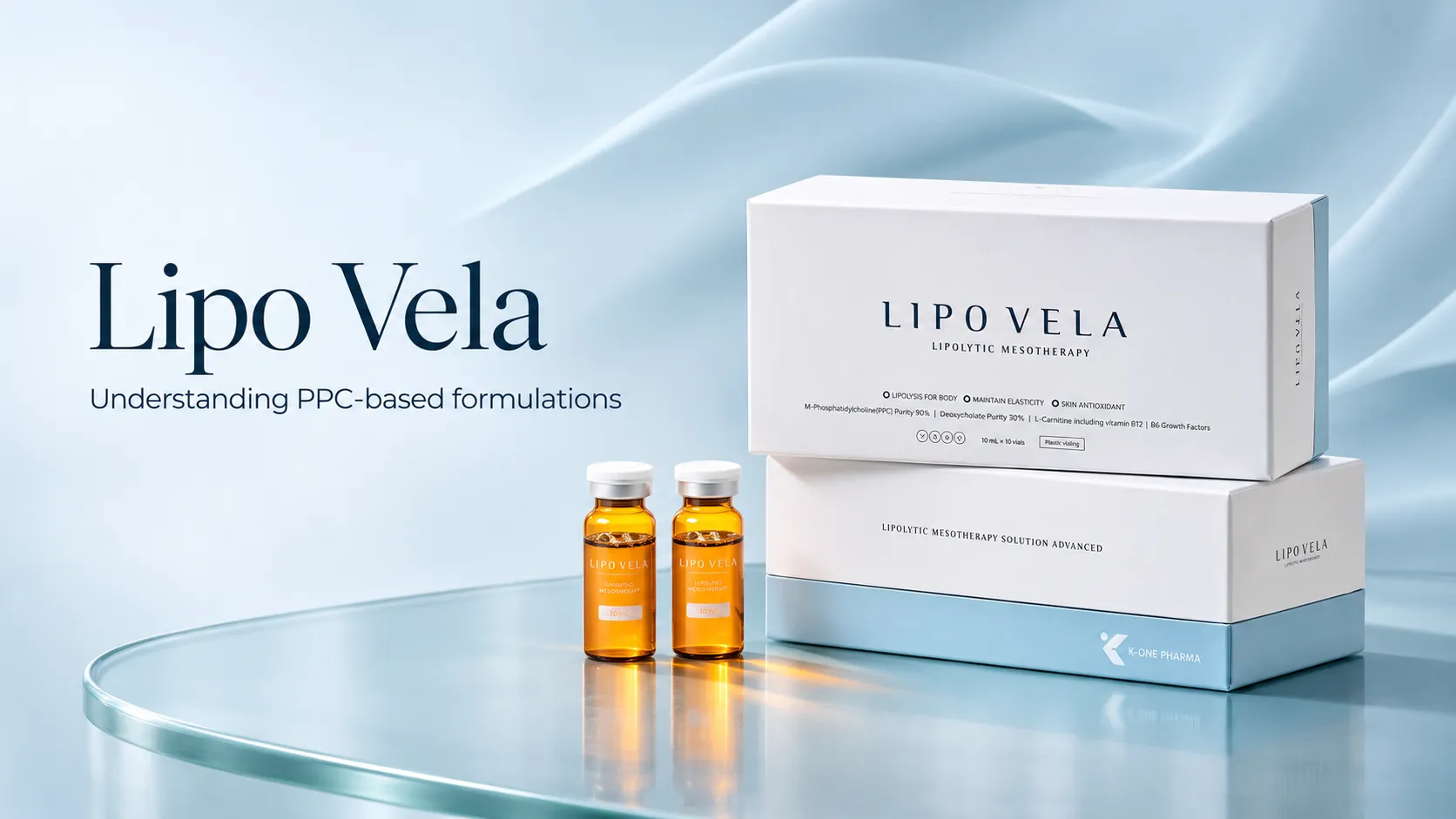
Lipo Vela is marketed as a phosphatidylcholine-based solution for localized body-contouring applications. Understanding it starts with the formula, not the phrase “fat dissolving.” Phosphatidylcholine, sodium deoxycholate, and supporting ingredients have different chemical roles, and the presence of one ingredient does not establish the performance of the finished product. The useful questions are what the formulation contains, which concern is being assessed, and how closely the available evidence matches that product.
The Lipo Vela listing identifies a body-focused presentation of ten 10 mL containers. This article explains how to interpret that format, distinguish PPC from deoxycholate, and compare product categories without confusing localized contouring with weight management. It also separates material science from claims about a particular commercial formula.
What PPC Means in a Formulation
Lipo Vela product information uses PPC to label its phosphatidylcholine ingredient. Phosphatidylcholine is a phospholipid associated with cell membranes. Its molecular structure includes a water-attracting region and fatty components. That combination makes phospholipids useful in biological membranes and formulation systems, where interactions with both water and lipids matter.
Calling a product “PPC-based” identifies a formulation theme. It does not tell the reader the complete ingredient concentrations, physical behavior, or expected clinical outcome. Two products with PPC in their descriptions can have different co-ingredients and substantially different supporting data. An ingredient name should therefore start a comparison rather than finish it.
One important distinction is between an ingredient’s normal biological role and the effects of a formulated product delivered to tissue. Phosphatidylcholine being present in cell membranes does not prove that an aesthetic formulation is gentle, selective, or interchangeable with naturally occurring membrane lipids. Context, concentration, and the complete formulation all change the scientific question.
This distinction also prevents an appealing but inaccurate shortcut: describing a product as a nutritional boost that simply persuades fat to disappear. Material identity, proposed mechanism, and a demonstrated treatment outcome are three separate layers of information. Keeping them separate makes both patient communication and product comparison more precise.
Why Sodium Deoxycholate Changes the Discussion
Sodium deoxycholate is a bile salt with detergent properties. It is chemically different from phosphatidylcholine, even when the two appear in the same formulation. Detergent action can disrupt cell membranes; it is not equivalent to the normal metabolic process of using stored fat for energy.
Rotunda and colleagues investigated a phosphatidylcholine formulation and isolated sodium deoxycholate using laboratory and tissue models. Their 2004 study identified deoxycholate as a major contributor to membrane disruption in the tested formulation. That finding helps explain why a PPC label alone gives an incomplete picture. It does not establish identical behavior for every subsequent branded product. [1]
Later laboratory work by Kim and colleagues explored differences between PPC and deoxycholate in cells and animals. The researchers reported different effects on mature adipocytes and inflammatory responses under their experimental conditions. These findings refine the scientific discussion, but they are not a clinical trial of Lipo Vela. [2]
The practical lesson is to avoid treating PPC and deoxycholate as synonyms or assigning all effects to a single headline ingredient. A useful description identifies the substances separately and explains that the finished formulation is the relevant unit of clinical evaluation. Mechanistic studies are valuable precisely because they answer narrower questions than advertising usually asks.
Reading the Product Presentation Without Overinterpreting It
K-one Pharma’s published Lipo Vela information lists phosphatidylcholine, sodium deoxycholate, L-carnitine, and vitamin B12, together with a ten-by-ten-milliliter presentation. [3] These details help identify a commercial product; they do not establish the contribution of every ingredient to a visible contour change.
For example, an ingredient’s involvement in normal metabolism is not sufficient evidence that adding it to this formula produces a clinically meaningful advantage. Likewise, a purity statement about a raw material should not be read as the concentration of that material in the finished solution. “High purity,” “high concentration,” and “greater clinical effect” describe different things.
The packaging arithmetic is straightforward: ten containers holding 10 mL each represent 100 mL of packaged solution. That number describes inventory, not a patient requirement, treatment count, or recommended amount. Comparing cartons by total volume can help with stock planning, but comparing clinical value requires more than milliliters.
Names also matter. Body and facial variants should be treated as distinct products until their own labeling establishes otherwise. A shared family name does not justify transferring an ingredient percentage, application area, or supporting study from one version to another. When discussing the body presentation, keep the full product name and package size together.
Comparing Contouring Product Categories
“Body contouring” can describe several different goals. A person may be concerned about a localized prominence, loose skin, surface texture, or a combination. Those are not interchangeable targets, so comparing products only by a broad category name is rarely useful.
| Category | Primary comparison question | Information that matters |
| PPC and deoxycholate formulations | Which exact formulation has been evaluated? | Ingredients, concentrations, product-specific evidence |
| Deoxycholic-acid medicines | What product and treatment area were studied? | Exact medicine, indication, relevant clinical trials |
| Device-based contouring | What tissue change is the device intended to produce? | Technology, treatment site, measured outcomes |
| Skin-quality products | Is the goal hydration, texture, or laxity? | Material properties and outcomes matching that concern |
| Volume-adding products | Is additional volume actually needed? | Intended purpose, tissue behavior, clinical assessment |
This table is a framework for asking better questions, not a ranking. A category can be appropriate for one concern while being irrelevant to another. A product intended to add volume, for instance, should not be judged by the same endpoint as an intervention intended to reduce a localized prominence.
The FDA describes noninvasive device-based contouring as a category that does not produce weight loss or the health benefits associated with weight loss. That distinction is useful when setting goals, although device guidance is not evidence for an injectable product. [4] Changes in body shape, overall body weight, and skin quality need separate assessment.
What Clinical Evidence Can Actually Tell You
A recognizable ingredient list is weaker evidence than a well-designed study of the finished formulation. A useful study identifies its product, participants, comparison group, assessment method, and follow-up period. Without those details, an impressive percentage can be difficult to interpret.
Reeds and colleagues conducted a small controlled study of a phosphatidylcholine-deoxycholate formulation in abdominal subcutaneous fat. Seven participants completed the study, and the authors reported a reduction in measured fat thickness alongside tissue changes. [5] The small completed sample and the particular formulation limit how broadly its findings should be applied.
For professional readers, the key question is not whether any PPC-related study exists. It is whether the product, formulation, body site, and measured outcome match the proposed comparison. A study of one mixture cannot supply a reliable response rate or treatment schedule for another brand merely because both mention PPC.
Photographs deserve the same care. Camera angle, posture, clothing pressure, lighting, and the interval between images can alter the apparent result. A meaningful assessment records these conditions consistently and uses a measure that fits the original concern. Visual improvement should not automatically be interpreted as a quantified reduction in fat.
Building a Clearer Product Conversation
A practical discussion begins with a description of the concern in ordinary language. “A small localized prominence” is more informative than “I need a slimming product.” “Loose-looking skin after weight change” identifies a different question. Describing the concern before naming a product reduces the chance of choosing a category for the wrong reason.
Next, distinguish the proposed outcome from the explanation offered for it. A mechanism describes how a material might act. An outcome describes what changed in people. A commercial claim should connect the two using relevant evidence rather than moving directly from an ingredient’s biochemical role to a promised visible result.
Finally, decide what would count as a worthwhile improvement. If a consultation uses photographs, ask how the images will be standardized. If it uses measurements, ask what is being measured. If several approaches are discussed, compare them against the same concern rather than comparing unrelated claims such as hydration, firmness, and circumference as though they were one endpoint.
Frequently Asked Questions
Is PPC another name for sodium deoxycholate
No. Phosphatidylcholine is a phospholipid; sodium deoxycholate is a bile salt with detergent properties. They can appear together, but their chemistry and experimental effects differ. Descriptions that collapse both into one “fat-burning ingredient” lose information that matters when interpreting research.
Does a ten by ten milliliter package indicate ten treatments
No. The package tells you the number of containers and their nominal volume. It does not establish how many people can be treated or how many visits a person requires. Those decisions cannot be calculated from the carton size alone.
Does higher ingredient purity mean stronger results
Not by itself. Purity describes the composition of a material, whereas concentration describes how much is present in a formulation. Neither independently establishes the finished product’s clinical effect. A meaningful comparison needs the complete formulation and relevant outcome data.
Are body and facial versions interchangeable
A related name is not enough to establish interchangeability. Versions can differ in composition, intended purpose, packaging, and supporting information. Compare each presentation on its own terms and avoid borrowing specifications from a different product simply because the branding looks similar.
What should a professional buyer compare first
Start with the exact product identity and the concern it is intended to address. Then compare the formulation and evidence against alternatives serving that same goal. This is more useful than ranking products by vial count, ingredient buzzwords, or a general promise of faster results.
Explore the Product Category With a Defined Goal
When reviewing the FillersFairy aesthetic product supplier catalog, begin with the product category and the information needed for a specific professional inquiry. For Lipo Vela, keep the body presentation, formulation questions, and relevant evidence together. A clear request for product information is easier to evaluate than a broad request for the strongest contouring solution.
References
1. Rotunda AM, Suzuki H, Moy RL, Kolodney MS. Detergent Effects of Sodium Deoxycholate Are a Major Feature of an Injectable Phosphatidylcholine Formulation Used for Localized Fat Dissolution. Dermatologic Surgery. 2004;30:1001-1008.
2. Kim JY, Kwon MS, Son J, Kang SW, Song Y. Selective Effect of Phosphatidylcholine on the Lysis of Adipocytes. PLOS ONE. 2017;12:e0176722.
3. K-one Pharma. LIPO VELA. Product information, accessed November 2026.
4. U.S. Food and Drug Administration. Non-Invasive Body Contouring Technologies. Accessed November 2026.
5. Reeds DN and colleagues. Metabolic and Structural Effects of Phosphatidylcholine and Deoxycholate Injections on Subcutaneous Fat A Randomized Controlled Trial. Aesthetic Surgery Journal. 2013;33:400-408.
