
This SpaceProxy review starts with failure instead of features. The service advertises individual IPv4, shared IPv4, IPv6/32 and MTProto, manual IP/subnet/city selection, unlimited traffic, up to 2,000 streams, instant activation, auto-renewal and an API. Those are attractive claims, but a useful review asks what happens when an IP is blocked, a location is wrong, a target dislikes the subnet, or concurrency creates application-level errors.
SpaceProxy is a static-proxy rental service, so destination reputation and routing matter as much as raw capacity. I therefore evaluated the offer as a red-team exercise: identify likely failure modes, map each one to a mitigation, and decide whether the pricing and control panel make recovery cheap enough for real operations.
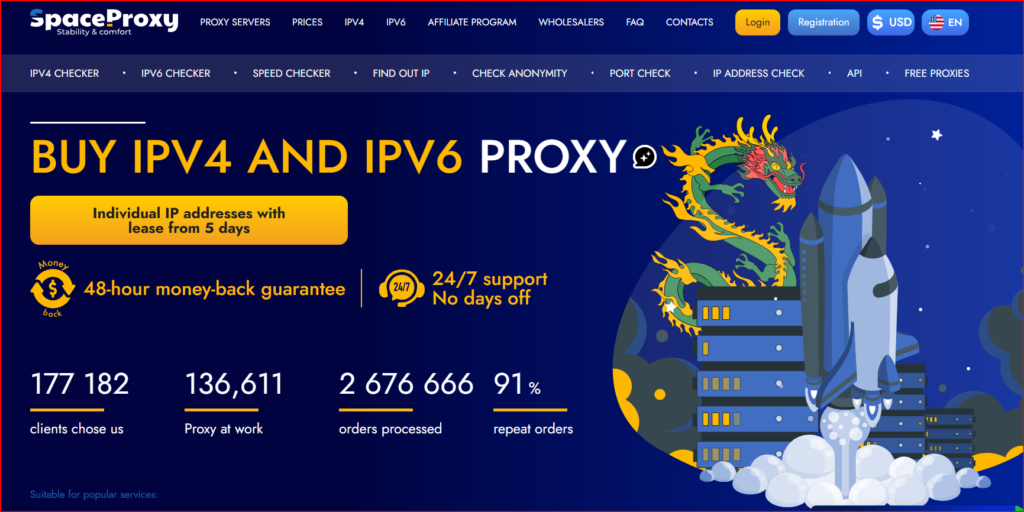
SpaceProxy homepage used as the introduction visual for this failure-first review.
| Red-team summary The service is attractive for low-cost fixed endpoints because short rentals, manual selection and inventory controls reduce the cost of experimentation. The main discipline is not to confuse “2,000 streams” or “unlimited traffic” with unlimited acceptance by target websites. |
Failure mode #1: the proxy connects, but the target rejects it
This is the most common proxy misunderstanding. A proxy can be technically alive while a marketplace, search engine or SaaS site treats the address poorly. The fix is not to assume the provider is broken or that the target is broken; the right response is to test more than one address/subnet, compare individual versus shared IPv4, and log the exact HTTP status, CAPTCHA pattern or session failure.
| Failure | Likely cause | Recovery path |
|---|---|---|
| Target blocks or challenges | IP/subnet reputation or target policy | Try another individual IPv4/subnet; reduce request rate |
| Wrong geo result | Geolocation database mismatch | Verify multiple databases; choose city/subnet manually |
| High error rate under concurrency | Target rate limits or client bottleneck | Ramp gradually; inspect response codes and local pools |
| IPv6 cannot complete flow | Target/client lacks full IPv6 support | Return to individual IPv4 baseline |
| Shared IP behaves inconsistently | Other users influence reputation | Move the workflow to individual IPv4 |
Failure mode #2: headline concurrency is misunderstood
SpaceProxy advertises up to 2,000 streams. That is useful as a provider-side concurrency allowance, but it is not a promise that one target will accept 2,000 simultaneous requests from one IP. The destination can impose its own rate limits, and your own code can fail because of connection pooling, DNS, CPU, file descriptors or retry storms. I would test concurrency as a ramp: 5, 20, 50, 100 and upward while recording response distribution, not as a one-step jump to the published ceiling.
Failure mode #3: the cheapest tier creates more manual work
The SpaceProxy price table makes it easy to start cheaply. Shared IPv4 is listed at $0.99 for 30 days, individual IPv4 starts at $1.77, and IPv6/32 starts at $0.51. Those numbers are excellent only when the selected tier works cleanly for the target. The right cost comparison includes failed requests and operator time.
| Type | Quantity | 5 days | 30 days | 90 days | 360 days |
|---|---|---|---|---|---|
| IPv4 Shared | 1-20 IPs | $0.67 | $0.99 | $2.97 | $11.88 |
| Individual IPv4 | 1-20 IPs | $0.96 | $1.77 | $5.31 | $21.24 |
| Individual IPv4 | 21-40 IPs | $0.91 | $1.74 | $5.22 | $20.88 |
| Individual IPv4 | 41-89 IPs | $0.89 | $1.56 | $4.68 | $18.72 |
| Individual IPv4 | 90-1000 IPs | $0.83 | $1.50 | $4.50 | $18.00 |
| IPv6/32 | 1-99 IPs | $0.10 | $0.51 | $1.53 | $6.12 |
| IPv6/32 | 100-199 IPs | $0.10 | $0.48 | $1.44 | $5.76 |
| IPv6/32 | 200-3000 IPs | $0.09 | $0.48 | $1.44 | $5.76 |
| MTProto | 1-20 IPs | $0.96 | $1.77 | $5.31 | $21.24 |
Failure mode #4: geography is assumed instead of verified
Manual city, subnet and IP selection is one of the strongest control features in the product. I would still verify every production location with independent databases because geolocation is not an absolute property stored inside the IP. Different databases can disagree. For SEO or localization work, keep a mapping of proxy, ASN, country/city result and the exact target behavior so the team can reproduce a good setup.
Failure mode #5: a good IP gets lost during maintenance
SpaceProxy says buyers can add or remove IPs during renewal and can use auto-renewal. That sounds mundane, but it matters operationally. Once a subnet has been proven on a difficult target, you want to preserve the working inventory rather than rebuild from scratch. A simple asset register—IP, location, subnet, target, credentials, first-use date and renewal date—turns cheap proxies into manageable infrastructure.
What the service gives you to recover
- Individual IPv4 as a cleaner baseline when shared reputation causes noise.
- Manual IP, subnet and city selection for more controlled geo testing.
- Five-day rental terms that keep experimentation cheap.
- A published 48-hour replacement/refund window that rewards fast validation.
- API and personal-account tooling for larger inventories.
- Auto-renewal plus add/remove-IP controls for maintaining a proven pool.
- Unlimited-traffic language, useful when transfer volume matters, while target-side limits still remain separate.
My stress-test sequence
- Baseline one individual IPv4 on the real target at low request rate.
- Validate geolocation and protocol behavior over HTTP/SOCKS5.
- Repeat with a second subnet to separate target behavior from one address.
- Ramp concurrency gradually while logging response codes and retry behavior.
- Introduce shared IPv4 only if the use case can tolerate shared reputation.
- Test IPv6 separately rather than assuming it is a drop-in substitute.
- Document renewal and replacement procedures before scaling beyond a small pool.
API, support and payment workflow under stress
SpaceProxy also publishes a multi-function API, a personal account, online support, crypto and conventional payment options, and an affiliate program. The API matters most after the manual workflow is understood: automate provisioning only after you know which product type, location and subnet characteristics work for the target. Otherwise automation simply scales mistakes faster.
I would also test the support path before a large order. Ask a specific inventory or configuration question, record the response time, and confirm what information support needs for a replacement request. Operational quality is not only whether a proxy is alive; it is how quickly a team can diagnose and recover when an address does not fit a target.
| What works well | What to verify / limitations |
Very low unit pricingFive-day rentals support inexpensive stress testingManual city/subnet/IP selectionIndividual, shared, IPv6 and MTProto tiersAPI and auto-renewalPublished unlimited traffic and high stream allowance | Static-IP reputation remains target-specific2,000 streams is not a target-side guaranteeShared IPv4 can inherit other-user reputationIPv6 compatibility must be provenLarge pools still require inventory discipline |
Failure-first conclusion
SpaceProxy looks strongest when a buyer expects some IPs to fail on some targets and designs the workflow around fast testing, replacement and inventory control. The product gives enough levers—short rentals, individual IPv4, manual selection, renewal editing and an API—to make that process economical. Buyers who want a turnkey residential rotation layer should compare a different category. Confirm current locations and terms on the official SpaceProxy website before scaling.
FAQ
What does “2,000 streams” mean in practice?
It describes provider-side concurrency capacity, not a guarantee that one website will accept 2,000 simultaneous requests from one IP.
Should I start with shared IPv4?
For a new or sensitive target, individual IPv4 is a better baseline because it removes simultaneous sharing as a variable.
Is unlimited traffic the same as unlimited requests?
No. Transfer limits and destination rate limits are separate issues.
How should I test geo accuracy?
Check more than one geolocation database and the actual regional behavior of the target website.
What is the value of a five-day rental?
It lets you stress-test real target compatibility before committing to a longer term.
