
I structured this ProxyStores review around four buyer personas because the catalog is easy to misuse when every product is reduced to price per IP. ProxyStores offers individual IPv4, shared IPv4, IPv6/32 and MTProto, with HTTP/SOCKS5 for the web products, manual IP/subnet/city selection, IP binding, automation, 48-hour replacement/refund language and immediate activation.
The right tier depends on what the buyer is protecting against: inconsistent reputation, lack of IPv6 compatibility, unnecessary cost, or simply the wrong protocol. By walking through four personas—SEO analyst, developer/QA engineer, budget researcher and Telegram operator—you can see where the same provider looks very different.
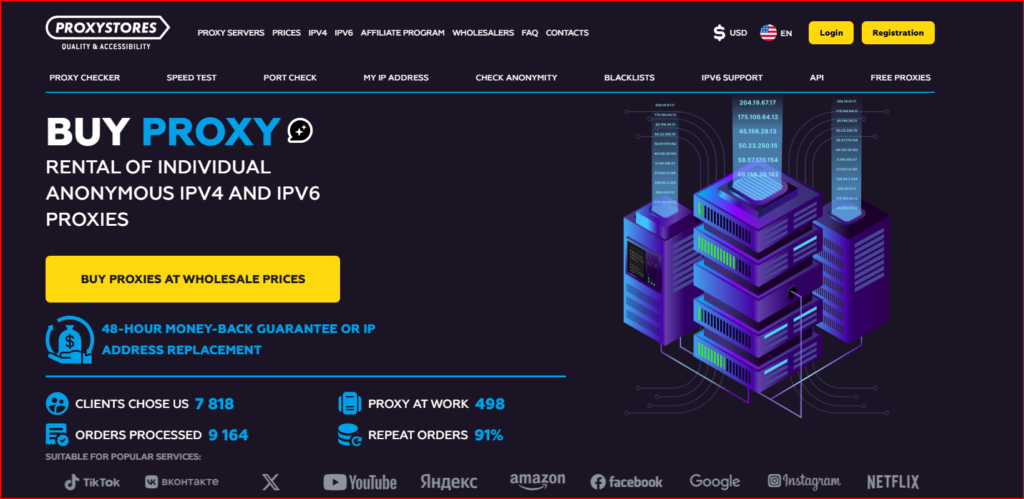
ProxyStores homepage used as the visual reference for this persona-based review.
| Persona summary Individual IPv4 is the safest general-purpose baseline; shared IPv4 is the budget option; IPv6/32 is the scale option when supported; MTProto is the specialized Telegram option. The value of ProxyStores is the ability to choose deliberately rather than forcing every workload into one pool. |
Persona A: the SEO/localization analyst
This user cares about stable geography, repeatable regional pages and the ability to compare results across markets. I would start with individual IPv4 because it reduces reputation noise and keeps the endpoint stable across repeated checks. Manual city and subnet selection are more useful here than a giant but uncontrolled pool. The analyst should verify the visible geolocation through multiple databases and record which IP maps to which regional test profile.
Persona B: the developer or QA engineer
A developer values predictable credentials, SOCKS5/HTTP compatibility, fast activation and the ability to reproduce a network path while debugging. Individual IPv4 again makes sense for baseline tests, while IPv6 is worth adding as a deliberate compatibility dimension. If the application has separate IPv4 and IPv6 behavior, cheap IPv6/32 inventory can turn that into a repeatable regression test rather than an occasional manual check.
Persona C: the cost-first public-data researcher
For public pages where occasional retries are acceptable, shared IPv4 can be rational. The researcher should expect the possibility of noisier reputation and design retries and target-specific limits accordingly. Shared addresses should not be treated as “bad”; they are simply a different risk/cost trade-off. If the project becomes sensitive or expensive to rerun, the economics often shift back toward individual IPv4.
Persona D: the Telegram-focused operator
MTProto is a separate category intended for Telegram connectivity. It should not be compared with HTTP/SOCKS5 as if they are interchangeable protocols. Buyers who need general browser or API proxying should use the web-oriented tiers; buyers who specifically need MTProto should evaluate it on Telegram connectivity and stability.
Commercial snapshot
The current ProxyStores pricing page shows five-, 30-, 90- and 360-day periods with volume bands. I would use the five-day term as a persona-specific proof of concept: the SEO analyst tests geo accuracy, the developer tests protocol compatibility, the researcher tests target acceptance, and the Telegram user tests MTProto behavior.
| Type | Quantity | 5 days | 30 days | 90 days | 360 days |
|---|---|---|---|---|---|
| IPv4 Shared | 1-20 IPs | $0.67 | $0.99 | $2.97 | $11.88 |
| Individual IPv4 | 1-20 IPs | $0.96 | $1.77 | $5.31 | $21.24 |
| Individual IPv4 | 21-40 IPs | $0.91 | $1.74 | $5.22 | $20.88 |
| Individual IPv4 | 41-89 IPs | $0.89 | $1.56 | $4.68 | $18.72 |
| Individual IPv4 | 90-1000 IPs | $0.83 | $1.50 | $4.50 | $18.00 |
| IPv6/32 | 1-99 IPs | $0.10 | $0.51 | $1.53 | $6.12 |
| IPv6/32 | 100-199 IPs | $0.10 | $0.48 | $1.44 | $5.76 |
| IPv6/32 | 200-3000 IPs | $0.09 | $0.48 | $1.44 | $5.76 |
| MTProto | 1-20 IPs | $0.96 | $1.77 | $5.31 | $21.24 |
Persona fit matrix
| Buyer | Best starting tier | Why | What to test first |
|---|---|---|---|
| SEO/localization | Individual IPv4 | Stable endpoint and lower shared-reputation noise | Geo accuracy and target consistency |
| Developer/QA | Individual IPv4 + small IPv6 set | Protocol and dual-stack validation | HTTP/SOCKS5 and IPv6 behavior |
| Budget researcher | Shared IPv4 | Lowest-cost fixed IPv4 | Block/challenge rate on public pages |
| Telegram workflow | MTProto | Protocol-specific product | Connection stability and target compatibility |
The common controls all four personas benefit from
- HTTP and SOCKS5 support for web-oriented proxy tiers.
- Manual IP, subnet and city selection for more deliberate inventory choice.
- Immediate post-payment activation for quick pilot tests.
- IP binding for controlled source environments.
- Add/remove-IP controls during renewal and auto-renewal for pool maintenance.
- Published 48-hour address replacement/refund language for fast post-purchase validation.
What I would not assume from the marketing page
I would not assume that a private IP is accepted by every target, that 100 Mb/s-class marketing language translates into identical application throughput everywhere, or that a country label guarantees every geolocation database will agree. Proxy infrastructure is partly target-dependent. The buyer’s advantage comes from having clear tiers and enough controls to test deliberately—not from avoiding testing entirely.
Operational detail: automation, support and order lifecycle
For teams with more than a handful of endpoints, the difference between a cheap proxy and an operationally cheap proxy is order management. ProxyStores advertises immediate activation after payment, a personal account, auto-renewal, and the ability to add or remove IPs during renewal. Those controls make it possible to keep a clean inventory instead of repurchasing blindly every month. I would maintain a simple register containing IP, subnet, intended target, protocol, country/city, first-use date, renewal date and any target-specific notes.
Support and replacement handling are also part of the product, not an afterthought. The published 48-hour replacement/refund language is most useful when the team begins validation immediately after purchase. A proxy that has not been tested against the real target within that window has not really been evaluated. The strongest operating habit is to test on day one, record failures clearly, and separate provider connectivity problems from target-side blocks or account rules.
Payment and scaling considerations
The site presents multiple payment methods and volume-oriented pricing. Large quantity discounts can look attractive, but I would not jump from a two-IP pilot to hundreds of addresses unless the buyer has already proven at least two subnets on the real destination. Scaling should preserve the configuration that worked: same protocol, same target logic, similar geography and conservative concurrency. Changing every variable at once makes debugging expensive.
| What works well | What to verify / limitations |
Clear product segmentationLow starting pricesHTTP/SOCKS5 plus MTProto optionManual city/subnet/IP selectionShort rentals for pilotsAutomation and renewal controls | Shared IPv4 trades cost for reputation controlIPv6 requires compatibility testingFixed proxies are not residential rotationGeo databases can disagreePrivate IPs still need target-specific validation |
Which persona should choose ProxyStores?
ProxyStores is strongest for buyers who know what kind of endpoint they need and want low-cost fixed inventory with practical selection controls. The service is less appropriate when the project specifically requires rotating residential/mobile traffic or a managed scraping layer. Match the tier to the persona, test a small order, then scale only the configuration that passes. Check live inventory and current terms on the official ProxyStores website.
FAQ
Which ProxyStores tier is the safest starting point?
Individual IPv4 is the cleanest baseline for most web workflows because it avoids simultaneous sharing.
When does shared IPv4 make sense?
When the task is low sensitivity, public, retryable and the cost reduction matters more than full reputation control.
Why test IPv6 separately?
Some websites and software still behave differently over IPv6, so compatibility needs to be proven rather than assumed.
What is MTProto for?
It is a Telegram-oriented proxy protocol and is not a substitute for general HTTP/SOCKS5 web proxying.
Can I choose a city or subnet?
ProxyStores advertises manual IP, subnet and city selection, subject to available inventory.
