
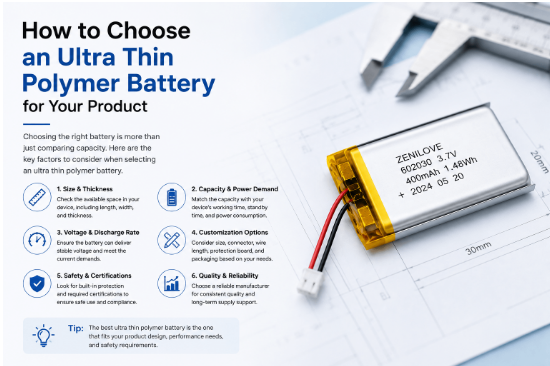
Choosing the right battery is not only about capacity. For many compact electronic products, thickness, shape, safety, and customization are just as important. If your product has a slim structure or limited internal space, an ultra thin polymer battery may be a better choice than a standard cylindrical cell.
A thin battery can help keep the product lightweight and compact. However, the right choice depends on more than size. Buyers also need to compare voltage, discharge rate, charging method, protection design, and production consistency.
Start with the Space Inside Your Device
The first step is to check the available space inside your product. For an ultra-thin polymer battery, thickness is often the most important limit. Even if a battery has enough capacity, it cannot be used if it does not fit the product structure.
Engineers should confirm the available length, width, and height before selecting a battery. They should also consider the space needed for wires, connectors, protection boards, and battery swelling tolerance.
This step is important because thin electronic products usually leave very little extra room. A small design change may affect the battery size. For this reason, battery selection should happen early in product development, not after the mechanical design is already fixed.
Match Battery Capacity with Real Power Demand
Capacity is important, but it should be matched with real power demand. A higher mAh value does not always mean a better battery choice. In a slim device, chasing higher capacity may increase thickness or make the battery harder to fit.
To choose the right capacity, product designers should estimate working current, standby current, daily use time, and charging frequency. A tracking tag, for example, may spend most of its time in standby mode. A wearable device with a display and Bluetooth function may need more frequent power output.
The goal is to choose a battery that supports the expected runtime without making the product too large or heavy. For many slim electronics, the best solution is a balance between capacity, size, and real usage patterns.
Check Voltage, Discharge Rate, and Charging Needs
Voltage and discharge performance are also important. Many ultra-thin polymer batteries are designed for low-power electronic devices, but not every device has the same power demand.
A simple sensor may only need a stable, low current. A Bluetooth device, small speaker, display module, or medical monitor may need stronger discharge performance during certain working periods. If the battery cannot support these peaks, the device may shut down or perform poorly.
Charging requirements should also be checked. Some products need fast charging, while others use slower and safer charging methods. The battery, charging circuit, and protection board should work together. This helps improve safety and long-term performance.
Consider Customization for OEM Product Design
Customization is one of the biggest advantages of polymer batteries. For OEM and ODM products, the battery often needs to match a specific internal layout.
A custom thin battery may include special dimensions, wire length, connector type, protection circuit, label, packaging method, or certification requirement. These details may seem small, but they can affect assembly, safety, and production efficiency.
For example, a wearable device may need a short wire and a compact connector. A smart card may need an extremely flat battery structure. An IoT sensor may need a battery that supports long standby time. A medical device may require stricter quality control and documentation.
Working with a polymer battery manufacturer that understands customization can make the development process smoother.
Pay Attention to Safety, Testing, and Certifications
Safety should never be ignored, especially for thin and compact batteries. A quality ultra-thin polymer battery should include suitable protection against overcharging, over-discharging, short circuits, and abnormal temperature conditions.
Testing is also important. Before mass production, the battery should be checked for capacity, internal resistance, cycle life, charging behavior, and physical stability. For products that will be shipped internationally, transport documents and certifications may also be required.
Buyers should not only ask whether the sample works. They should also ask whether the supplier can maintain consistent quality in mass production. Stable batch quality is important for commercial products, especially when the battery is used in consumer electronics, medical devices, or industrial IoT equipment.
Choose the Battery That Fits the Product, Not Just the Datasheet
An ultra-thin polymer battery should be chosen based on the full product design, not only the specification sheet. Size, capacity, voltage, discharge rate, safety, charging method, and customization all need to work together.
For slim electronic products, the best battery is not always the one with the highest capacity or the lowest price. It is the one that fits the device, supports the required performance, and can be produced consistently.
By starting with product space, calculating real power demand, and checking safety requirements, buyers can make a more practical battery decision. A well-matched ultra thin polymer battery can improve product design, user experience, and long-term reliability.
