
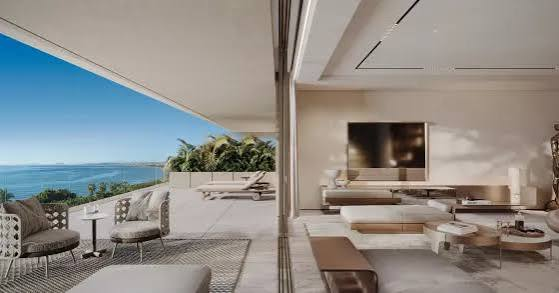
Drive the coast road between Malaga and Sotogrande today and the built landscape reads very differently from the one that defined the region in the 1980s and 1990s. The pastiche Andalusian villa, all arches, terracotta and wrought iron, has given way over the past fifteen years to a confident contemporary vocabulary. By 2026 that shift is close to complete at the upper end of the market, and it has changed what buyers expect and what architects deliver.
From decorative to structural
The defining move has been the replacement of ornament with structure. Where an older villa signalled quality through applied detail, a contemporary Costa del Sol home does it through the frame itself: long horizontal lines, cantilevered floors, and openings sized to the view rather than to a fixed window proportion. Glazing has become the primary material, with sliding systems that retract fully to erase the boundary between living space and terrace. In a climate that delivers roughly 320 days of usable outdoor weather, that indoor to outdoor continuity is the single most valued feature.
The palette narrowed as the forms opened up. White render, natural stone, large format porcelain and warm timber accents now do most of the work, chosen for how they weather in strong coastal light rather than for decorative effect. The result is a house that photographs cleanly but, more importantly, ages without looking dated, which matters in a market where resale is never far from the buyer’s mind.
Orientation as the first decision
The best contemporary homes on the coast are designed around the sun path before anything else. South and south west orientation captures the sea view and the evening light, but it also brings heat load, so serious specifications now pair the glazing with deep overhangs, external shading and high performance solar control glass. A house that looks striking but overheats by mid afternoon is a design failure the market has learned to spot. Anyone assessing property for sale on the Costa del Sol at this level should read orientation and shading strategy as closely as the finishes.
Light on this coast is unusually strong, and it exposes weak detailing. Architects working here have learned to design the shading as carefully as the glazing, because a terrace that is unusable at three in the afternoon in July defeats the purpose of the sliding walls that open onto it. Pergolas, brise soleil and deep reveals are used not as decoration but as climate control, and a buyer should ask to see how a house performs in high summer as well as how it looks in a spring photograph.
The infrastructure behind the aesthetic
What is not immediately visible has become as important as the elevation. Contemporary builds in the region now routinely integrate:
- Aerothermal or geothermal heating and cooling in place of older gas and electric systems.
- Home automation for climate, shading, lighting and security, controlled as one system.
- Photovoltaic provision and, increasingly, battery storage, reflecting both energy cost and buyer expectation.
- Insulation and airtightness specified to the cooler winter months, not just the summer.
These are no longer premium extras at the top of the market. They are the baseline a discerning buyer assumes, and their absence in an otherwise handsome contemporary house is now a negotiating point rather than a detail.
There is also a growing attention to how a contemporary home meets its plot. The strongest recent work steps down a sloping site rather than flattening it, keeping the mature planting and using level changes to separate living from sleeping and private from social space. That respect for the ground is part of what now distinguishes a considered design from a generic white box, and it is increasingly what the market rewards on resale.
Where the style goes next
The direction of travel in 2026 is towards quieter, warmer contemporary work: softer material palettes, more timber and stone against the render, and a move away from the starkest all white minimalism of a few years ago. Landscaping has become part of the architecture rather than an afterthought, with mature planting and water used to temper the hard geometry. For the coastline as a whole, the effect is a built environment that finally matches the ambition of the setting, and a design language that has proved durable enough to define the region for the next decade.
For anyone reading the coastline as a design story, the arc is clear. In a generation the Costa del Sol moved from imitation to invention, and the contemporary work now defining it is confident enough to age gracefully rather than chase a passing trend.
