
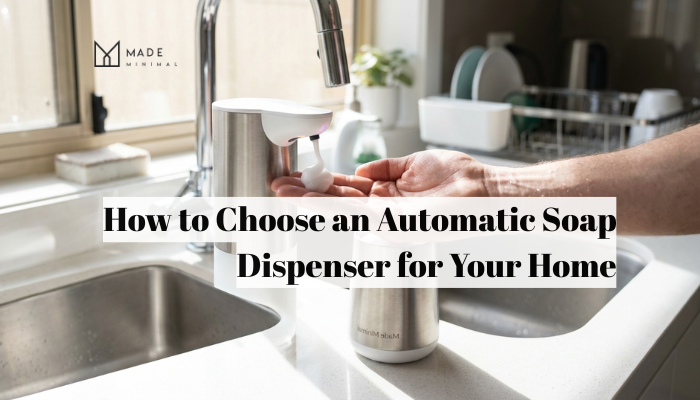
A good automatic soap dispenser for you should align with your space, usage habits, and the type of soap you plan to use. In fact, plenty of models crowd the shelves at homewares stores across Australia. But most differ in installation style, power source, and how well they handle different soap formulas.
At Made Minimal, we’ve spent years testing automatic soap dispensers in our Brisbane showroom. Some work beautifully with any liquid soap you add, while others clog after a few weeks or miss your hands half the time.
To help you sort through these differences, this guide breaks down what separates a reliable dispenser from one that’ll frustrate you daily. Plus, you’ll learn which features are important for your bathroom and which ones just add cost.
Let’s dig in.
Types of Automatic Soap Dispensers Worth Considering
Different dispenser styles suit different bathroom layouts and installation preferences. So, what works in a rental won’t make sense in a home you own, and the dispenser that fits a cramped ensuite might look out of place on a double vanity.
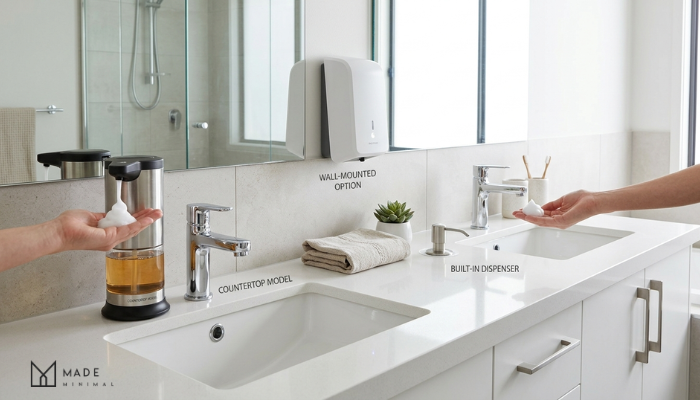
However, we’ve noticed that most people choose based on counter space first and aesthetics second. Here’s how each type of dispenser brings advantages that are worth considering:
Countertop Models for Easy Access
A countertop automatic soap dispenser sits directly on your sink without any installation. You unbox it, add liquid soap, and you’re done. Frankly, this is what most people start with
Because of this simplicity, the portable design lets you move it between rooms when needed. It’s also appealing to renters who can’t make permanent modifications. Plus, if the dispenser stops working after a few years, you don’t have to alter your space.
Wall-Mounted Options to Save Space
Mounting the dispenser on the wall frees up valuable counter space in cramped bathrooms and kitchens. You can even attach them directly to the wall above or beside the sink.
In addition to saving space, most models mount with screws or heavy-duty adhesive backing. And mounting it on the wall keeps the automatic dispenser safely out of children’s reach, particularly toddlers who love pressing buttons and making foam appear everywhere.
Built-In Dispensers for a Sleeker Look
You can install these dispensers directly into the countertop. As a result, the soap reservoir stays hidden in the cabinet below, with only the pump nozzle visible above. This setup creates the cleanest look and can even add resale value to your home in Australia’s property market.
However, installation requires professional help and changes to your countertop. Once installed, the unit stays fixed in place and can’t be moved.
What Powers Your Automatic Soap Dispenser?
Automatic soap dispensers run on batteries, rechargeable USB power, or direct plug-in connections.
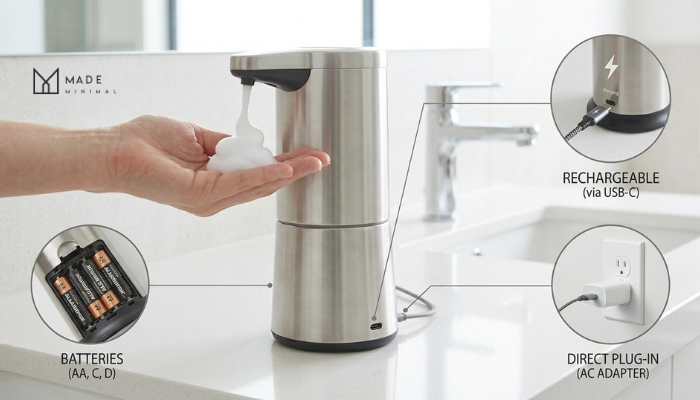
The power source affects where you can place the dispenser, how often you’ll need to maintain it, and what happens when it runs out. Some people don’t mind swapping batteries every few months. Whereas others would rather plug something in and forget about it.
Let’s have a look at what truly powers your automatic soap dispenser:
Battery-Operated Dispensers
Battery-operated models run on standard AA or AAA batteries and don’t need a power outlet. You might be surprised how long quality batteries last in these dispensers. And since there’s no cord involved, the design allows flexible placement anywhere near your sink.
Also, battery life ranges from two months to one year, depending on household size and how often people use the dispenser. For instance, larger households will go through batteries faster, but the upfront cost stays lower than rechargeable options.
Rechargeable USB Models
A built-in battery powers these models, which recharge using a USB cable, like your phone or tablet. At companies like Made Minimal, the automatic foam soap dispenser uses this power method and offers Afterpay instalments to spread the cost over time.
In day-to-day use, a single charge lasts three to six weeks. This eliminates recurring battery expenses, though you’ll need to remember to plug it in occasionally. Plus, the charging port usually sits at the base or back of the unit.
Plug-In Options
You can constantly power the plug-in dispensers through a wall outlet. They even offer a zero-maintenance feature for battery changes or charging cycles, which means one less thing to track.
However, placement becomes more limited here. You’ll need to stay close to an outlet, and the cord can add clutter to your counter. For example, in kitchens with outlets near the sink, this option works well. But in bathrooms where outlets sit farther from vanities, it can be less practical.
Capacity and Refill Frequency: Finding Your Sweet Spot
Larger tanks mean fewer refills, but the right size depends on your household traffic. Here, usage patterns differ, as a family of five drains a small reservoir in days, while a couple refills it monthly.
From our in-home testing with Brisbane households, most people underestimate how much liquid soap they’ll use once an automatic dispenser makes handwashing easier.
So, think about the following refilling tolerance before buying:
- Compact 200ml Tanks: Tight spaces benefit from these smaller units, though you’ll refill weekly. Guest bathrooms and powder rooms work well with this capacity since the pump doesn’t see constant use.
- Standard 400ml Models: In average Australian homes, about two weeks pass between refills. This size balances convenience with a footprint that doesn’t take over your counter space.
- Jumbo 800ml+ Reservoirs: Large families can go a month or longer between fills, assuming you’re not running a daycare. These take up more room but save you from constantly hunting for the soap bottle.
Bottom line: Match the tank size to how often you’re willing to refill rather than just the space available.
Liquid Soap Compatibility and Sensor Accuracy
Let’s be honest here. Most automatic soap dispensers work with standard liquid soap, but thick foaming formulas often create problems with the pump mechanism. That’s why the viscosity is more important than brands admit.
In practice, thin liquid soap flows through the dispenser tubing smoothly, while dense foam soap can clog the internal pump after a few weeks of use. Many websites like Made Minimal provide dispenser handles that address this issue automatically rather than requiring proprietary refills. It saves customers money over the years.
Alongside soap compatibility, sensor accuracy plays a big role in daily use. Most models detect hands between 5 and 10 cm from the nozzle. A shorter range here means you need to position your hands precisely under the dispenser to activate it.
Although longer sensor ranges offer more flexibility, the sensor sometimes activates accidentally when you’re just reaching for something nearby, wasting soap in the process.
Furthermore, volume adjustment features let you control how much soap dispenses per use. Some people prefer a small pump for quick hand rinses, while others want enough foam for a proper wash. So you should always check whether the model you’re considering offers this control.
In short, fixed-volume dispensers work fine, but adjustable ones give you more flexibility as your needs change over time. The touch-free operation, meanwhile, only creates value when the sensor actually meets your hands where you naturally place them.
Your Next Steps for Choosing the Right Dispenser
The right automatic soap dispenser depends on your available space, how often you’re willing to refill it, and which liquid soap formulas you prefer using. Those three factors will narrow your options faster than reading dozens of customer recommendations online.
Most dispensers in Australia offer similar touch-free convenience, but the differences in pump quality, foam consistency, and sensor accuracy show up after weeks of daily use. A model that works well in a shop display might not meet your household’s needs over the years.
Browse the collection at Made Minimal to find automatic soap dispensers built for Australian homes. Our team explains which models handle different soap types best and offer flexible payment options to make buying easier.
