
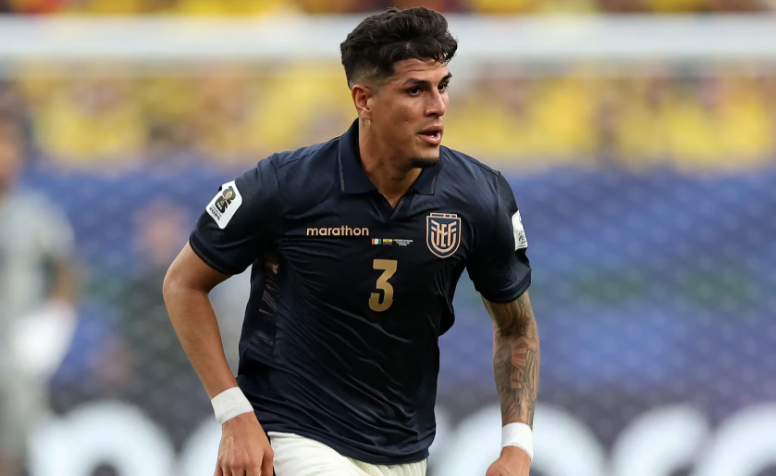
According to Goaldaddy https://goaldaddy.io/, Piero Hincapié does not fit the template of the modern, ball-playing centre-back. He is something more disruptive. At twenty-four, the Ecuadorian defender has already been described by his managers as a “warrior” and a “beast”, terms that evoke the raw physicality of a different era. Yet the analytical profile that emerges from his first season at Arsenal reveals a player whose value is not merely destructive. Hincapié is a defender whose physical dominance serves a specific tactical function, and whose versatility across two positions gave Mikel Arteta the flexibility to convert a twenty-two-year title wait into a Premier League triumph.
From Esmeraldas to the Emirates: The Making of a Physical Outlier
Piero Hincapié was born on 9 January 2002 in Esmeraldas, a province on Ecuador’s northern coast, and his football education began at Independiente del Valle, one of South America’s most respected talent factories. The analytical story of his development is not one of gradual technical refinement, but of a physical profile that was immediately abnormal. Miguel Ángel Ramírez, the manager who gave him his professional debut, recalled that during pre-season training, senior professionals were being outshone by a seventeen-year-old whose physical output “broke the GPS data every single day”. Speed, sprints, accelerations, high-intensity actions—the metrics that define modern defensive football were already at elite levels before he had played a single senior match.
He won the U20 Copa Libertadores with Independiente del Valle in 2020, moved briefly to Talleres in Argentina, and then joined Bayer Leverkusen in August 2021. Across four seasons in Germany, he made 166 appearances and was part of the squad that won the Bundesliga unbeaten in 2023–24. The Leverkusen education exposed him to Xabi Alonso’s structured, possession-oriented football, but it did not dilute the physicality that had defined him. It sharpened it into a weapon.
The Arsenal Loan and the Dual-Role Solution
Arsenal signed Hincapié on loan in the summer of 2025 with an obligation to make the move permanent for approximately €40 million. The analytical rationale was immediate: Hincapié could play both centre-back and left-back, and Arsenal needed depth in both positions. His first season in north London produced thirty-nine appearances across all competitions, split almost evenly between the two roles—twenty-two at centre-back and nineteen at left-back. He started twenty league games for a defence that conceded just twenty-seven goals, the fewest in the division, and the club activated his permanent transfer in June 2026 on a contract until 2031.
The analytical significance of the dual role is not merely that Hincapié is capable of playing in two positions. It is that he performs both functions without a discernible drop in effectiveness. As a centre-back, his physical strength and aerial presence allow him to dominate duels and defend the box. As a left-back, his recovery pace and aggressive stepping-in make him a reliable one-on-one defender in wide areas. Arteta described him as a “warrior”, and the statistical record supports the characterization: in only his second start of the season, against Slavia Prague in the Champions League, he became the first Arsenal player in twelve years to achieve a 100 percent duel success rate from eight or more duels in a single match.
- See more: https://goaldaddy.io/ตารางคะแนนฟุตบอล/
The Statistical Shape of a Specialist in Physicality
The analytical profile of Hincapié is concentrated in a specific cluster of metrics. His overall duel success rate in his first Arsenal season was the highest of any player in the squad, albeit across a limited sample. In a league that increasingly rewards defenders who can progress the ball and defend in space, Hincapié’s profile is a reminder that the fundamental currency of defending—winning the ball back—remains decisive.
His progressive passing numbers place him in the top five percent of Premier League defenders, with 4.2 progressive passes per ninety minutes, and his defensive actions per ninety sit at 2.8, also in the top five percent. These are not the numbers of a purely reactive defender. They describe a player who wins possession and then initiates the transition, a defender whose physicality is the starting point of Arsenal’s attacking phases rather than the end of them.
The weaknesses in his analytical profile are the predictable corollaries of his strengths. He is not a delicate, line-breaking passer in the mold of a deep-lying playmaker. His value lies in the disruption of opposition attacks and the acceleration of his own team’s transitions. In a system that already contains defenders capable of more refined distribution, Hincapié’s role is complementary rather than comprehensive—and that complementarity is precisely why he fits.
Ecuador, the World Cup, and the Unfinished International Arc
Hincapié’s international career has followed a parallel trajectory of physical dominance and tactical utility. He captained Ecuador at under-17 level and has accumulated over fifty senior caps, representing his country at the 2022 World Cup and the 2026 tournament in North America. At the 2026 World Cup, he played the full match in Ecuador’s opening group fixtures and was part of a defensive unit that also included Willian Pacho of Paris Saint-Germain, a pairing that FIFA described as “pillars” of the national team.
The international chapter is not without complication. Hincapié was sent off in the final minutes of Ecuador’s round-of-16 match against Mexico, a moment that introduced a note of disciplinary uncertainty into an otherwise upward trajectory. At twenty-four, he remains within the age range in which a defender’s decision-making matures, and the next World Cup cycle will offer the opportunity to convert his physical dominance into the kind of composed, error-free leadership that defines the best international defenders.
Conclusion: The Value of Being Unfashionable
Piero Hincapié’s analytical profile is not the profile of a fashionable modern defender. He does not dictate tempo. He does not spray diagonal passes. He does not invert into midfield. What he does is win duels, cover ground, and provide his manager with a tactical option that few squads possess: a defender equally effective at centre-back and left-back, whose physical output is so anomalous that it once broke the GPS at his first club.
At twenty-four, he is a Premier League champion, a permanent Arsenal signing, and an established international. The comparisons that follow him—to the “warriors” and “beasts” of defensive football’s past—are not nostalgic. They are analytical descriptions of a player whose value lies in the unglamorous, irreducible work of stopping opponents and starting attacks. Arsenal’s title-winning defence conceded twenty-seven goals in his first season. Hincapié did not score many of the goals or provide many of the assists. But he was central to the structure that made those numbers possible. In an era that often measures defenders by what they do with the ball, Hincapié is a reminder that what they do without it remains the foundation of everything else.
