
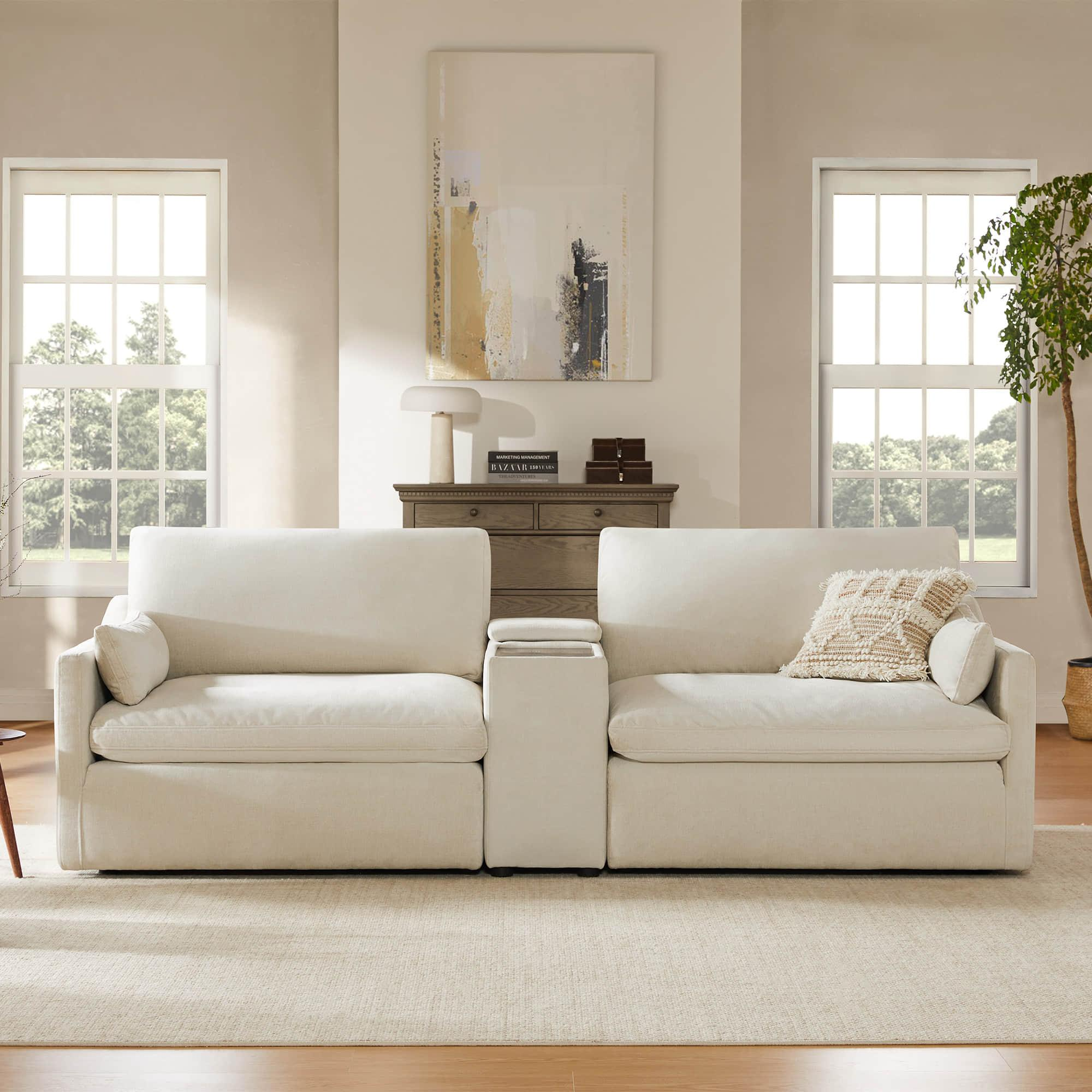
Most people shopping for living room seating assume the full-size sofa is the default and everything else is a downsized version of it. That assumption is why so many apartments end up with a couch that technically fits the wall but leaves no room to walk past it. A love seat flips the priority: instead of buying the largest thing that fits, you buy the thing that makes the room work.
Two seats are enough for the vast majority of actual use. Couples share one; a single person uses two cushions as a place to read, nap, and host a friend. The piece takes up less visual weight, leaves the floor open, and often lets you add a chair that turns a tight room into a proper conversation area. None of this is a compromise if the seating is chosen well.
This guide looks at what a love seat sofa genuinely solves, where it beats a full sofa, and how to choose one that holds up instead of sagging within a couple of years.
The Problem Two Seats Quietly Fix
Living rooms are usually asked to do several jobs at once, and a single large sofa tends to dominate all of them. It dictates the walkway, blocks the window, and forces the coffee table into whatever space is left. A love seat changes the arithmetic. Shaving a couple of feet off the width often frees a path along a wall, opens the view out of a window, or creates room for a side table that makes the seating usable rather than decorative.
There is a visual argument as well. Large sofas carry a lot of mass, and in a room with a low ceiling or a modest footprint that mass presses down on everything around it. A two-seater with visible legs and a lower back reads lighter, and the wall behind it can hold art that would otherwise be hidden. The piece also stops dictating where the television has to go, because the seating angle can shift with the furniture instead of being locked to one long wall.
The geometry of conversation is often better as well. Two people sharing a full sofa tend to sit apart, leaving a cushion of empty space between them. A narrower seat encourages people to actually sit together, and it can be angled toward a second chair or an armchair without crowding the room. The result is a grouping that reads as intentional — a place to sit and talk — rather than a single oversized object pushed against a wall.
Where It Does Not Work
Honesty matters here. If you regularly host five or six people for movie nights, a love seat alone will not do it, and you should plan for additional seating from the start. The same is true if anyone in the household is tall enough that a shallow two-seater leaves their legs unsupported. A love seat works best as the primary seat for two or three people, with a chair or two brought in for larger groups.
Planning the Room Around Two
Placement is where a small sofa earns its keep. The instinct is to push it against the longest wall, but that usually leaves the room feeling like a corridor. Instead, float it slightly forward and angle it toward the focal point — a fireplace, a television, a view. Even a few inches off the wall creates depth, and the space behind can take a slim console or a lamp.
Circulation Comes First
Before deciding on a position, walk the path people will actually take. Leave at least thirty inches between the front edge of the seat and the nearest other piece so two people can pass without turning sideways. Check that the arms do not block a doorway swing, and confirm the piece does not sit in front of a heating vent or a baseboard radiator. A love seat is small enough that these conflicts are usually fixable with a few inches of adjustment — which is precisely the advantage over a full sofa.
Pairing Without a Matching Suite
Two-seater sofas look best when they are part of a conversation rather than a matched set. Pair one with a single armchair in a different but related finish, add a round side table at arm height, and put a floor lamp behind one shoulder rather than overhead. A rug large enough to sit under both the sofa’s front legs and the chair’s back legs ties the group together visually. If the room is long, a pair of matching love seats facing each other can replace a sectional without blocking the flow of the space.
Getting It Through the Door
Small furniture is not automatically easy furniture. Measure the front door, the stairwell turn, and the elevator before delivery day, then compare against the sofa’s overall width and its diagonal depth. The two-seater’s advantage is that its narrow dimension is usually the width, which makes it far easier to angle through a tight hallway than a long sofa. Remove the feet if they unscrew, and keep the packaging until the piece is in place — a return is much harder once the carton is gone.
Once inside, protect the floor while positioning. Sliders under the legs let one person move the piece without lifting, and felt pads prevent the scratching that comes from dragging. If the sofa has a reversible bench cushion, rotate it every few months so the foam wears evenly and the seat keeps its shape.
Comfort Is Not Proportional to Size
A smaller seat can be considerably more comfortable than a bigger one, because comfort comes from proportions rather than from width. Seat depth should let you sit with your back against the cushion and your feet flat on the floor — usually around twenty to twenty-two inches for most adults. A seat that is too deep forces you to slide forward or tuck your legs, and no amount of extra width fixes that.
Cushion construction matters just as much. Foam that is dense enough to recover its shape will keep the seat supportive for years, while a softer fill feels luxurious for a month and then begins to collapse. Feather-blend tops over a firm core give the sink-in feel without the permanent dents, and a frame built from kiln-dried hardwood resists the creaking and flexing that cheaper frames develop.
The Case for Genuine Leather
Upholstery decisions deserve more thought than color alone. Genuine leather is forgiving in a way fabric is not: it wipes clean, resists pet hair, and softens with use instead of pilling or fading in patches. In a room where the sofa is the piece people actually live on, that resilience matters. Look for full-grain or top-grain hides, which age far better than bonded leather, and treat the surface once or twice a year to keep it supple.
Fabric remains a good choice if texture and warmth are the priority, but choose a tight weave with a high rub count, especially in homes with pets or children. Removable, washable covers are worth the small premium, and a performance finish helps with the spills that inevitably land on the seat closest to the kitchen.
Flexibility Over the Long Run
Rooms change. People move, children arrive, work-from-home setups appear and disappear. A love seat that is part of a modular system can grow or be rearranged without replacing the whole purchase, which is a practical argument for choosing pieces that can be added to later. CHITA LIVING’s modular seating follows that logic, letting a two-seat arrangement be extended when the room allows. Even without modularity, a compact sofa is easier to move, easier to reupholster, and easier to place in a future home than an oversized one.
Small Seating, Better Living
A love seat is not a lesser sofa. It is a different answer to the same question: how do you make a room comfortable without letting the furniture decide how the room gets used? Two well-proportioned seats, a sensible frame, and a fabric or leather that can take daily life will usually serve a household better than a wide couch that crowds everything else out.
Measure the walkway before the wall, choose depth and cushion density over width, and leave room to add a chair later. Do that, and the smaller piece will feel like the right size rather than the affordable compromise.
