
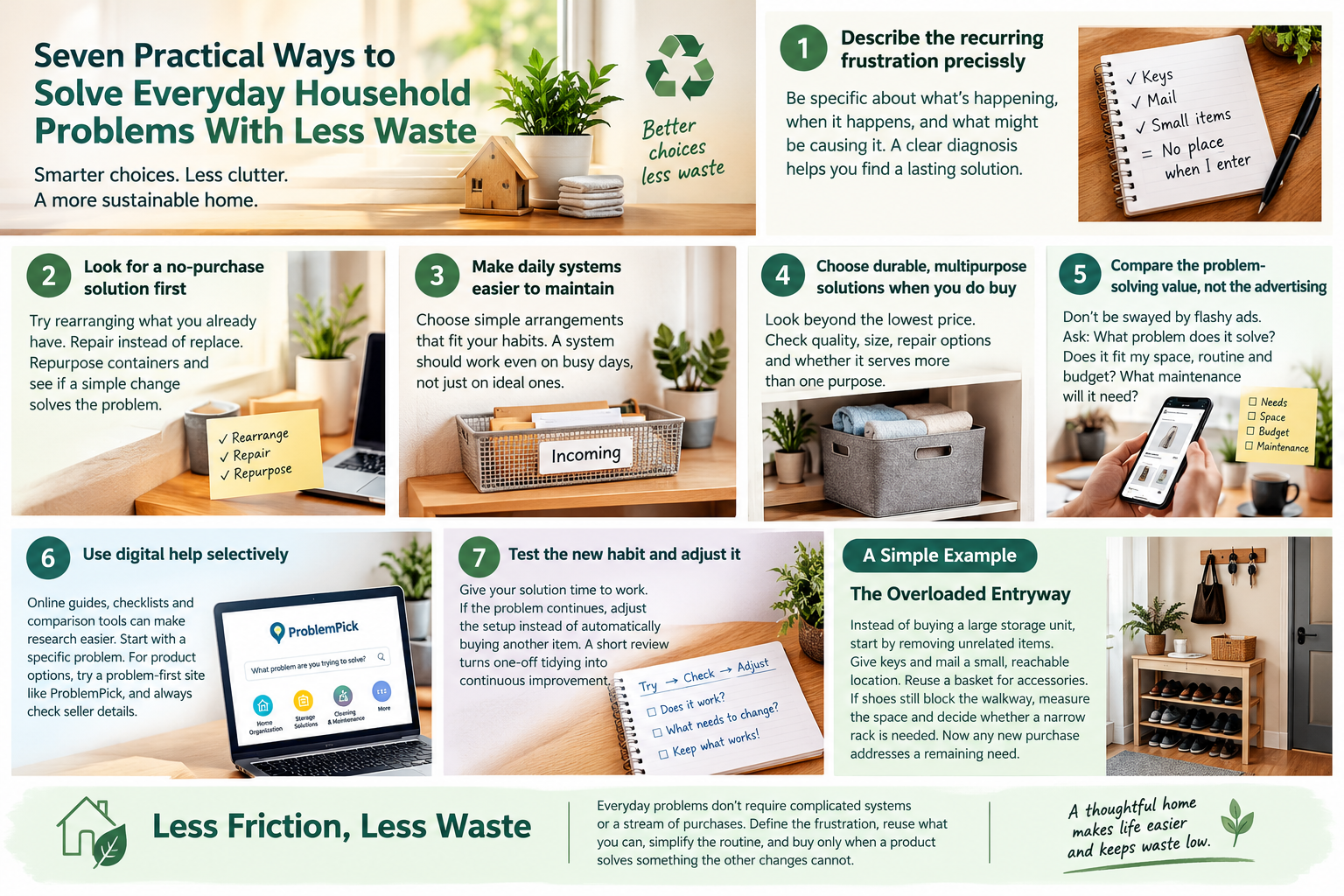
Small household frustrations can add up: a crowded cupboard, a desk that never stays organized, repeated purchases of items you already own, or a routine that requires more time than it should. When a problem keeps returning, buying another product can feel like the easiest solution. Sometimes it helps. Often, a simpler change in how you use what you already have works better.
A practical, lower-waste approach starts by finding the cause of the problem, trying the least complicated fix, and purchasing something new only when it has a clear job to do. Here are seven ways to make everyday household decisions more deliberate.
1. Describe the recurring frustration precisely
“Everything is a mess” is hard to solve. “The keys, mail, and small accessories have no assigned place when I enter the house” is much easier. The more specific the description, the more likely you are to find a lasting fix.
Spend a few minutes observing when the problem appears. Does it happen during busy mornings? Is it caused by too little storage, awkward placement, or a routine nobody follows consistently?
A clear diagnosis keeps you from treating the visible symptom while the source remains unchanged.
2. Look for a no-purchase solution first
Before ordering another organizer, storage box, or appliance, consider whether rearranging existing items would solve the issue. Can you move frequently used objects closer to where they are needed? Can you repair an item rather than replace it? Can an unused container be repurposed?
For example, a cluttered worktable may not need a new shelf. It may simply need fewer objects on the surface, a place for charging cables, and a rule for returning supplies after use.
Trying a small, reversible change first gives you useful information without spending money or adding unnecessary belongings.
3. Make daily systems easier to maintain
An elaborate organizational system often fails because it takes too much effort to use. Choose arrangements that work even on a busy day.
If paperwork tends to pile up, a single labeled incoming tray may be more realistic than several complicated folders. If reusable shopping bags are always forgotten, store one near the exit rather than expecting yourself to remember it at checkout.
The best system fits how people behave in the home. Design around actual habits rather than an ideal routine nobody has time to follow.
4. Choose durable, multipurpose solutions when you do buy
Some household problems genuinely require a new item. In that case, look beyond the lowest price and ask how long it is likely to remain useful. Check materials, measurements, repair or replacement options, and whether the object serves more than one purpose without becoming inconvenient.
A compact, sturdy storage solution that fits an existing shelf may be more helpful than a larger product requiring a room redesign. A tool with straightforward maintenance may offer better long-term value than one with many features but difficult-to-find parts.
Buying less does not mean never buying. It means making each purchase more purposeful.
5. Compare the problem-solving value, not the advertising
Marketing can make small inconveniences feel like emergencies. Bright photographs and dramatic before-and-after claims are not proof that an item will help in your particular home.
Start with three questions:
● What specific difficulty is this product supposed to fix?
● Does it fit the space, routine, and budget I already have?
● What maintenance, storage, or replacement needs will it create?
If these questions are difficult to answer, pause rather than buying on impulse. A recommendation tool may help generate a shortlist, but the final test is whether an item meets a real need.
6. Use digital help selectively
Online guides, checklists, and comparison tools can make practical research easier. A search for a specific issue—such as organizing charging cables in a shared study area—usually provides more relevant ideas than a broad search for “best home products.”
When a purchase is appropriate, a problem-first site like ProblemPick can help you explore product options by starting with the challenge you want to address. Check details and seller terms separately, and keep non-purchase solutions in the mix whenever they would work just as well.
The important point is to use technology to reduce unnecessary searching, not to create pressure to purchase.
7. Test the new habit and adjust it
Once you try a solution, give it a reasonable opportunity to work. If you move cleaning supplies to a more convenient place, notice whether the routine becomes easier over the next several uses. If you introduce a new storage system, check whether items are actually being returned to it.
If the problem persists, adjust the setup rather than automatically buying an additional item. Perhaps the storage is in the wrong location, the steps are too complicated, or the original diagnosis missed something.
A short review turns one-off tidying into continuous improvement.
A simple example: the overloaded entryway
Imagine a household where shoes, keys, mail, and bags collect at the door. A shopping-first approach might involve ordering a large new storage unit. A problem-first approach looks at what people place down when they arrive and why.
Begin by removing unrelated items. Give keys and mail a small, reachable location. Reuse an existing basket for accessories. If shoes still block the walkway, measure the available space and decide whether a narrow rack would genuinely help. Now any new purchase addresses a remaining need, rather than serving as the first response to disorder.
Less friction, less waste
Everyday problems do not require complicated systems or a stream of purchases. Define the frustration, reuse what you can, simplify the routine, and buy only when a product solves something the other changes cannot. A thoughtful household is not one with the most organizers or gadgets. It is one where the solutions make daily life easier without creating avoidable waste.
