
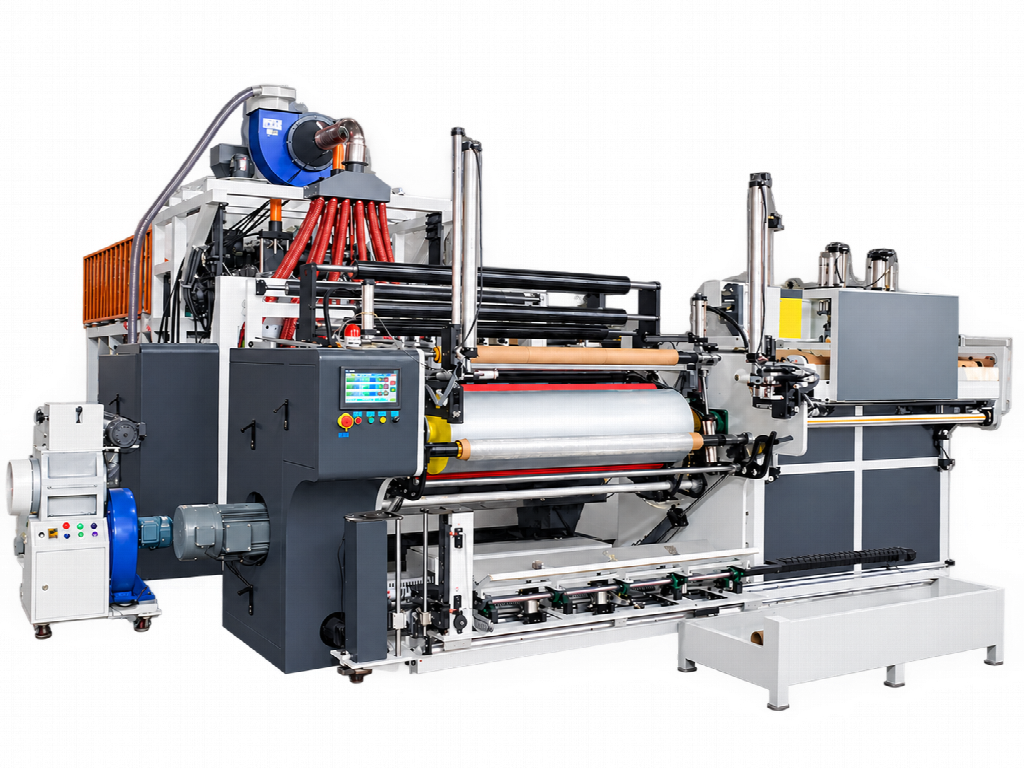
Stretch film is widely used for securing products, pallets, and loads during storage and transportation. Although the finished material is relatively simple in appearance, producing consistent stretch film requires careful control of several manufacturing processes.
As packaging manufacturers face different requirements for film width, thickness, roll size, and production volume, production equipment needs to provide more than basic extrusion capability. Stable material processing, controlled film formation, reliable winding, and efficient operation all contribute to the overall performance of a stretch film production line.
Modern equipment is increasingly designed around this idea: production efficiency depends not only on how quickly film can be produced, but also on how consistently the equipment can maintain the required production conditions.
Why Production Stability Matters
In film manufacturing, small variations can affect the final product.
Changes in temperature, material flow, film thickness, cooling conditions, or winding tension can influence the appearance and performance of the finished film. If these variables are not properly controlled, manufacturers may need to make frequent adjustments during production.
Production stability therefore becomes an important part of efficiency.
A stable production line allows operators to spend less time correcting process variations and more time monitoring normal production. It can also make repeat orders easier to manage because established production parameters can be used as a reference.
For manufacturers supplying customers with consistent film specifications, repeatability is particularly important.
The Importance of Controlled Film Thickness
Film thickness is one of the basic characteristics manufacturers need to control.
Stretch film is produced in relatively thin gauges, so maintaining an even thickness across the film width can be challenging. Uneven thickness may affect mechanical performance, stretching behavior, and material consumption.
Consistent material flow through the extrusion and film-forming sections is therefore essential.
Temperature control also plays an important role. Polymer material needs to reach a suitable processing condition before it can be formed into film. Stable temperatures help maintain predictable material flow and reduce unnecessary variations during production.
The objective is not simply to make thinner film. It is to produce film that maintains the intended characteristics consistently throughout the roll.
Tension Control During Film Production
Tension is another important factor in stretch film manufacturing.
The film passes through several stages before it becomes a finished roll. If the tension is too high, the film may be subjected to unnecessary stress. If tension is too low or unstable, film handling and winding can become more difficult.
Modern production lines can coordinate film speed and tension to provide more controlled film handling.
This becomes particularly important when production speed changes or when manufacturers switch between different film specifications.
Consistent tension can contribute to more uniform winding and help operators maintain stable production conditions over longer runs.
Winding Quality Affects the Finished Product
The winding section is sometimes overlooked when manufacturers evaluate film production equipment.
However, the quality of the finished roll depends partly on how the film is collected.
A properly wound roll should maintain an appropriate level of tightness and alignment. Problems during winding can result in uneven rolls, telescoping, wrinkles, or other handling issues.
As the roll diameter increases, the winding conditions also change. Automated control systems can help compensate for these changes and maintain more consistent winding conditions throughout the process.
Good winding performance is therefore closely connected with both product quality and production efficiency.
Automation Helps Operators Manage Production
Automation has become an important part of modern plastic film manufacturing.
A Wintech stretch film machine can integrate important production functions such as temperature management, film transport, speed control, tension regulation, and winding into a coordinated system.
Instead of relying entirely on manual adjustments, operators can monitor production parameters through a centralized control interface.
This does not remove the need for experienced operators. Instead, it gives them better visibility into the production process and allows them to respond more efficiently when operating conditions change.
Automation can also help make production settings more repeatable. When a manufacturer receives a repeat order with similar specifications, previously established parameters can provide a useful starting point.
Production Speed and Overall Efficiency
Higher production speed is naturally attractive to manufacturers, but speed should not be considered separately from stability.
A production line operating at a high theoretical speed may not provide better overall efficiency if it frequently requires adjustments, generates excessive waste, or produces inconsistent rolls.
A more practical approach is to balance production speed with film quality and operating stability.
For example, maintaining stable material flow and controlled film tension can help reduce production interruptions. Reliable winding can also make finished rolls easier to handle and package.
The most useful measure of efficiency is therefore not simply how fast a machine can operate, but how effectively it can maintain productive operation under normal manufacturing conditions.
Flexibility for Different Film Specifications
Packaging manufacturers may not always produce one standard type of stretch film.
Customer requirements can vary in terms of film width, thickness, roll dimensions, and application. Some manufacturers may also need to adjust production according to different market requirements.
Production equipment should therefore provide an appropriate level of flexibility.
A flexible system allows manufacturers to adjust relevant operating parameters without unnecessarily complicated procedures. This can be useful for businesses that need to produce multiple specifications on the same production platform.
However, flexibility should always be balanced against process stability. Every change in material or specification needs to remain within the appropriate operating range of the equipment.
Material Efficiency Is Also Important
Raw material represents a significant part of film production costs, which means material utilization should also be considered when evaluating production efficiency.
Stable production conditions can help reduce unnecessary waste caused by process adjustments, start-up problems, or inconsistent film formation.
Accurate control of film thickness can also help manufacturers use material more efficiently. Producing film at the required specification without excessive thickness can reduce unnecessary material consumption while maintaining the intended product performance.
This makes process control relevant not only to product quality but also to manufacturing economics.
Maintenance and Long-Term Operation
Production efficiency depends on more than machine performance during normal operation. Maintenance also has a direct effect on equipment availability.
Manufacturers should consider how easily key components can be inspected, cleaned, adjusted, or replaced.
Regular maintenance can help identify potential problems before they develop into significant production interruptions.
When purchasing film production equipment, manufacturers should therefore consider spare parts, technical support, operator training, documentation, and maintenance accessibility alongside the machine’s production specifications.
A production line that is easy to maintain can provide practical advantages throughout its operating life.
What Manufacturers Should Evaluate
When comparing stretch film production equipment, manufacturers can consider several factors together rather than focusing on a single specification.
Important considerations include:
- Film width and thickness requirements
- Expected production capacity
- Material compatibility
- Temperature control
- Film thickness consistency
- Tension control
- Winding performance
- Automation level
- Changeover requirements
- Maintenance accessibility
- Technical support
- Future production needs
This broader evaluation can help manufacturers select equipment that matches their actual production environment.
It also helps avoid choosing equipment solely because it has a high maximum speed or a particular headline specification.
Building a More Efficient Production Process
Modern stretch film manufacturing is increasingly focused on coordination between different stages of production.
Extrusion, film formation, cooling, film transport, tension control, and winding all influence one another. When these processes are properly coordinated, manufacturers can maintain more stable operating conditions and improve production consistency.
Automation provides another layer of control by allowing operators to monitor important parameters and make adjustments when necessary.
For manufacturers, the result is a production process that can be easier to manage and more adaptable to changing requirements.
Conclusion
Efficient stretch film production is not simply about producing more film in less time. It involves maintaining consistent quality, controlling material usage, managing film tension, producing uniform rolls, and reducing unnecessary production interruptions.
Modern production equipment can support these objectives by integrating process control, automation, film handling, and winding into a coordinated system.
For packaging manufacturers, evaluating equipment from this broader perspective can make it easier to identify a production solution that supports both current requirements and future development.
As packaging applications continue to evolve, stable and controllable film production will remain an important part of efficient manufacturing.
