
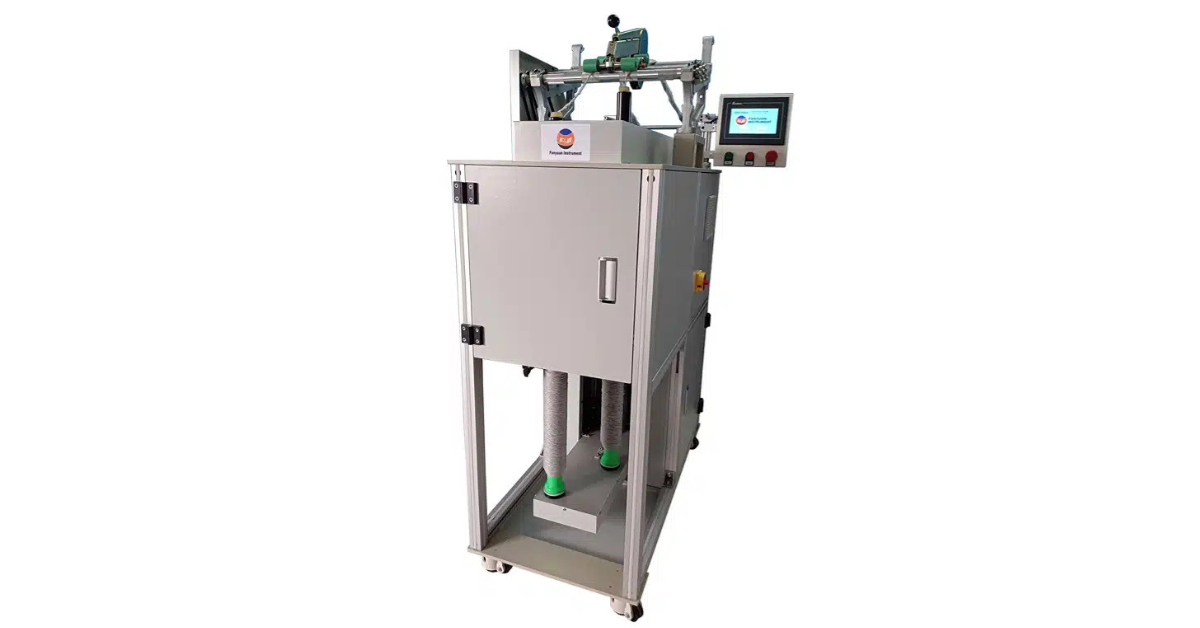
Lab Roving Machine is widely used in textile laboratories where the main goal is to evaluate fiber and yarn quality under controlled conditions. In quality-focused environments, consistency and precision are more important than production speed. A laboratory roving machine allows technicians and researchers to prepare roving samples that can be tested and compared scientifically.
Instead of depending on large industrial equipment, laboratories rely on this compact system to prepare uniform roving for inspection, testing, and analysis. This helps ensure that every experimental result is based on stable and repeatable conditions.
Importance of Roving in Quality Testing
Roving acts as a bridge between silver and yarn. If roving quality is poor, the final yarn will also be weak or uneven. A lab roving machine allows technicians to prepare roving with known parameters so they can:
- Measure roving uniformity
- Analyze the strand strength
- Observe fiber cohesion
- Study the thickness variation
These tests help determine whether the raw material is suitable for spinning or needs further processing.
Supporting Laboratory Measurement Standards
In textile testing, maintaining standard conditions is essential. A lab roving machine allows operators to:
- Fix drafting ratios
- Control spindle speed
- Apply a uniform twist
- Maintain consistent winding tension
This makes it easier to follow laboratory testing standards and compare different fiber samples fairly. Reliable roving preparation improves the accuracy of tensile strength tests, evenness tests, and yarn performance evaluations.
Use in Comparative Fiber Studies
Researchers often compare two or more fiber samples to decide which performs better. A lab roving machine enables:
- Processing fibers under the same mechanical conditions
- Eliminating variation caused by machine differences
- Creating comparable roving samples
For example, cotton from two regions can be converted into roving using the same settings. Any difference in roving quality then reflects fiber properties rather than machine behavior.
Role in Blend Ratio Experiments
Textile laboratories frequently experiment with fiber blends such as cotton-polyester or wool-acrylic. A lab roving machine helps:
- Prepare blended silver into roving
- Test the stability of mixed fibers
- Study blending behavior during drafting
This is especially useful for developing new yarn products or improving existing blend formulas.
Visual Inspection and Structural Study
Another advantage of laboratory roving machines is the ability to visually inspect roving structure. Operators can examine:
- Fiber alignment
- Twist distribution
- Surface smoothness
- Strand compactness
This visual analysis helps detect drafting faults and fiber separation issues that may not be visible at later stages.
Contribution to Yarn Property Prediction
Yarn quality is strongly influenced by roving quality. By preparing consistent roving samples, laboratories can:
- Predict yarn strength
- Estimate yarn regularity
- Anticipate spinning behavior
This allows manufacturers to correct problems early, before full-scale production begins.
Value in Training Quality Control Staff
Quality control teams need to understand how roving affects yarn performance. A lab roving machine helps train staff to:
- Recognize roving defects
- Adjust drafting and twist
- Interpret test results
This practical training improves inspection skills and reduces quality problems in industrial spinning.
Stability for Long-Term Testing Projects
Many research projects require testing over long periods. A lab roving machine provides:
- Stable mechanical performance
- Repeatable parameter settings
- Reliable output over time
This stability is essential for long-term studies where data consistency matters.
Reducing Experimental Error
One of the biggest challenges in textile research is experimental error. A lab roving machine reduces error by:
- Standardizing roving preparation
- Minimizing human variation
- Producing uniform samples
This leads to more trustworthy conclusions and stronger technical reports.
Role in Pre-Production Validation
Before launching new yarns or fiber blends, companies often validate them in the laboratory. A lab roving machine supports this by:
- Producing test roving
- Identifying potential spinning problems
- Optimizing process parameters
This validation stage helps prevent costly mistakes in large-scale manufacturing.
FAQs
Q1: Why is a Lab Roving Machine important for quality testing?
It prepares uniform roving under controlled conditions, which improves the accuracy of fiber and yarn evaluation.
Q2: Can it be used for fiber blend studies?
Yes, it is ideal for testing blended fibers such as cotton-polyester or wool-acrylic.
Q3: How does roving quality affect yarn?
Roving quality influences yarn strength, evenness, and spinning stability.
