
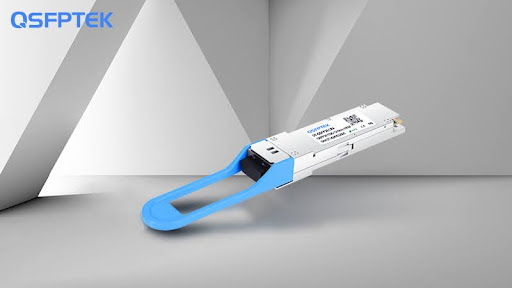
As data centers continue to scale in size and complexity, the demand for high-bandwidth, stable, and long-reach optical connectivity has increased significantly. 100G modules have become a fundamental building block in modern data center networks, enabling operators to support growing east-west traffic and increasingly distributed architectures. Among these solutions, the 100G QSFP28 LR4 optical module is widely adopted for medium- to long-distance transmission scenarios. Operating at a 1310 nm wavelength over single-mode fiber and supporting transmission distances of up to 10 km, this module provides a practical balance between reach, performance, and deployment flexibility, making it well suited for large-scale and high-density data center environments.
Understanding the Role of 100G LR4 in Data Center Networks
The 100GBASE-LR4 QSFP28 optical module is designed to transmit 100 Gbps of data by multiplexing four optical lanes over a duplex single-mode fiber pair. Each lane operates at a distinct wavelength around the 1310 nm window, allowing efficient wavelength division multiplexing while maintaining compatibility with standard LC connectors. This architecture makes LR4 particularly suitable for data center environments where longer reach is required without introducing the complexity of DWDM systems.
In practice, 100G LR4 modules are often positioned as a core connectivity solution rather than a short-reach interconnect. Compared with multimode-based solutions such as 100G SR4, LR4 enables network architects to overcome distance limitations and reduce dependency on parallel fiber infrastructure, which can become cumbersome in large-scale deployments.
Applications in Spine-Leaf Architecture
Spine-to-Leaf Interconnections
The spine-leaf architecture has become the dominant topology in modern data centers due to its predictable latency and horizontal scalability. In this design, every leaf switch connects to each spine switch, resulting in a dense mesh of high-speed links. While short-reach optics may suffice in compact data halls, larger facilities often exceed the practical reach of multimode fiber.
In such scenarios, 100G LR4 modules are commonly deployed on spine-to-leaf links to ensure consistent performance across extended distances. Their 10 km reach provides ample margin for cable routing, cross-connects, and future layout changes. This flexibility is particularly valuable in hyperscale or colocation data centers, where physical distances between rows or halls can vary significantly.
Supporting High Port Density Switches
Modern spine and leaf switches support high port densities, often accommodating dozens of 100G ports in a single chassis. The QSFP28 form factor of LR4 modules allows operators to fully utilize these ports without increasing rack space or power consumption excessively. While LR4 modules generally consume more power than short-reach alternatives, their ability to replace multiple parallel fiber links can simplify cabling and improve overall manageability.
Core and Aggregation Layer Deployment
Core Network Connectivity
Beyond the access layer, 100G LR4 modules play an important role in the core and aggregation layers of data center networks. These layers require highly reliable, high-capacity links to aggregate traffic from multiple leaf domains and route it toward upstream networks or data center interconnects. The stability and reach of LR4 modules make them well suited for this purpose, particularly when fiber paths extend across multiple floors or buildings.
Because LR4 modules operate over standard single-mode fiber, they integrate seamlessly with existing fiber infrastructure that may already support other long-reach optical technologies. This compatibility reduces the need for costly re-cabling when upgrading network speeds from 40G or lower data rates to 100G.
Long-Term Scalability Considerations
From a planning perspective, deploying 100G LR4 in the core layer can also serve as a transitional step toward higher-speed technologies. Single-mode fiber installed for LR4 links can later support 400G or even 800G optics, protecting long-term infrastructure investments. This forward compatibility is one of the reasons LR4 remains relevant even as higher data rates gain market traction.
Data Center Interconnect and Long-Distance Links
Inter-Building and Campus Connectivity
Many data centers operate across multiple buildings or campuses, requiring reliable optical links that extend beyond a single facility. With a maximum reach of 10 km, 100G LR4 modules are well suited for inter-building connections, metro-edge data centers, and campus-scale networks. They provide sufficient distance coverage without the added cost and complexity of extended-reach modules such as ER4.
In these deployments, LR4 modules are often used to establish high-capacity trunks that aggregate large volumes of east-west and north-south traffic. Their use of duplex single-mode fiber simplifies fiber management and reduces the physical footprint of interconnect cabling.
Supporting Disaster Recovery and Redundancy
Longer-reach optical links are also critical for disaster recovery and redundancy planning. By enabling geographically separated data halls to operate as a unified environment, 100G LR4 modules help improve resilience and business continuity. The ability to maintain high bandwidth over extended distances ensures that replication traffic and backup operations do not become performance bottlenecks.
Practical Deployment Considerations
Fiber Quality and Link Budget Planning
Successful deployment of 100G LR4 modules depends heavily on proper fiber quality and link budget planning. Single-mode fiber must meet appropriate attenuation and dispersion specifications to ensure stable transmission at 1310 nm. While the nominal reach is 10 km, real-world factors such as connector loss, splicing, and patch panel insertion loss should be carefully evaluated during network design.
Monitoring and Maintenance with DDM
Most 100G LR4 modules support Digital Diagnostic Monitoring, allowing operators to track parameters such as optical power, temperature, and voltage in real time. Leveraging DDM data can significantly improve operational visibility and help detect potential issues before they lead to link failures. In large data centers, this capability is essential for proactive maintenance and efficient troubleshooting.
Compatibility and Interoperability
Ensuring compatibility with switches and routers from different vendors is another key consideration. Although 100G LR4 follows industry standards, interoperability testing is recommended, especially in multi-vendor environments. Using compatible or third-party-tested modules can help control costs while maintaining reliable performance.
Conclusion
The 100G QSFP28 LR4 optical module remains a cornerstone technology for modern data center networks that require high bandwidth and extended reach. Its ability to support spine-leaf architectures, core aggregation links, and inter-building connectivity makes it a versatile solution across multiple deployment scenarios. By carefully considering fiber infrastructure, link budgets, and monitoring capabilities, data center operators can fully leverage the strengths of 100G LR4 modules to build scalable, resilient, and future-ready networks.


